From ashes to empire. From furnace fire to city lights. The stories of resilience, industry, and human spirit that define Pittsburgh.
This is not a story of perfection. It's a story of perseverance. Of a city destroyed and rebuilt. Of workers who endured impossible heat to forge America's steel. Of immigrants who arrived with nothing and built everything. This is Pittsburgh—where resilience runs deeper than three rivers, and pride is earned through fire.
GALLERY I
The Great Fire & Pittsburgh's Indomitable Spirit | April 10, 1845
On April 10, 1845, Pittsburgh burned. One-third of the city—1,200 buildings—consumed by fire. Lesser cities would have crumbled. Pittsburgh rebuilt in brick and stone, tripling its population in twenty years and emerging stronger than before. This is where Pittsburgh's character was forged: not in prosperity, but in the refusal to stay down.
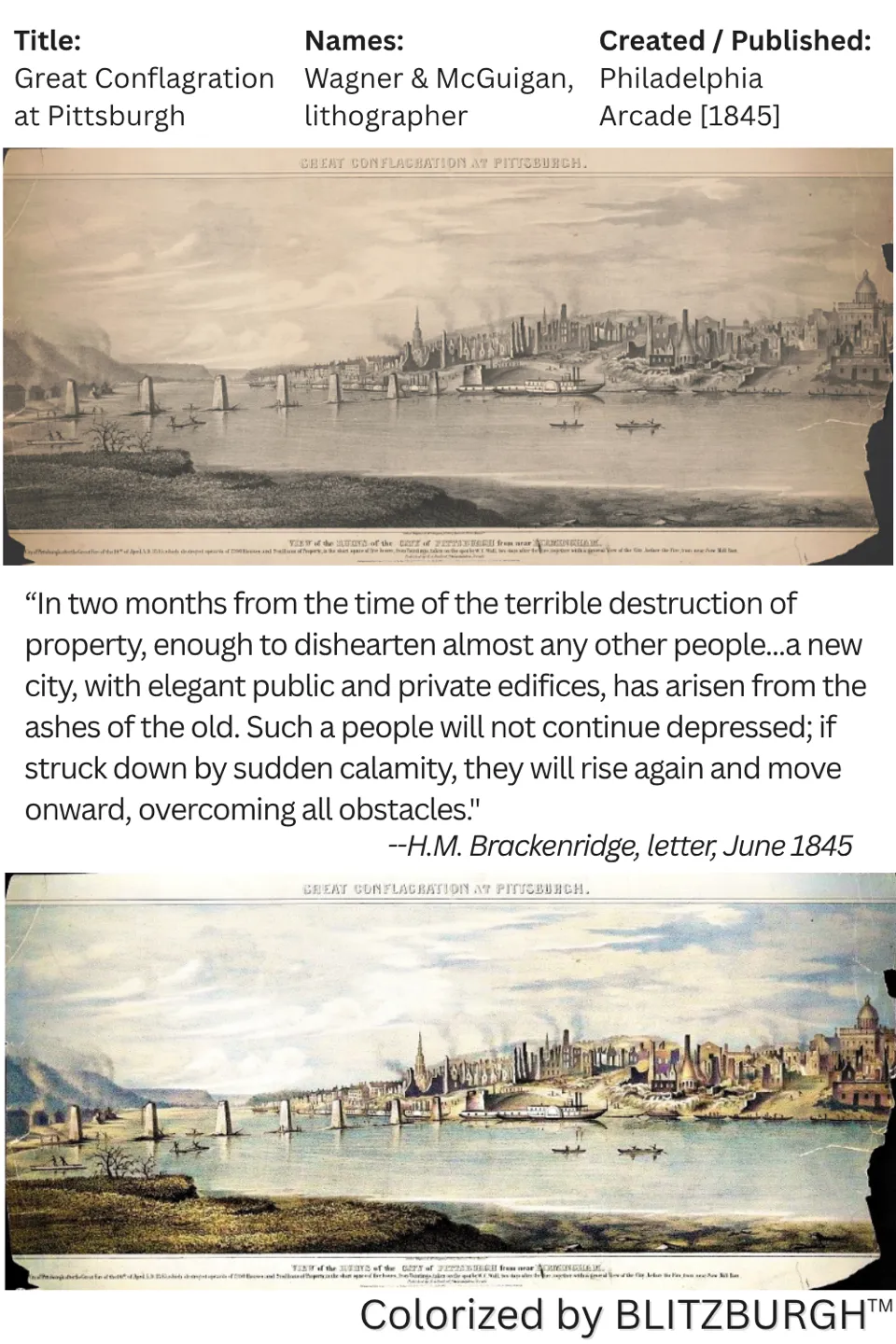
Wagner & McGuigan's lithograph captured Pittsburgh's destruction in 1845. One thousand two hundred buildings gone. Families homeless. Businesses destroyed. The city stood at the edge of ruin.
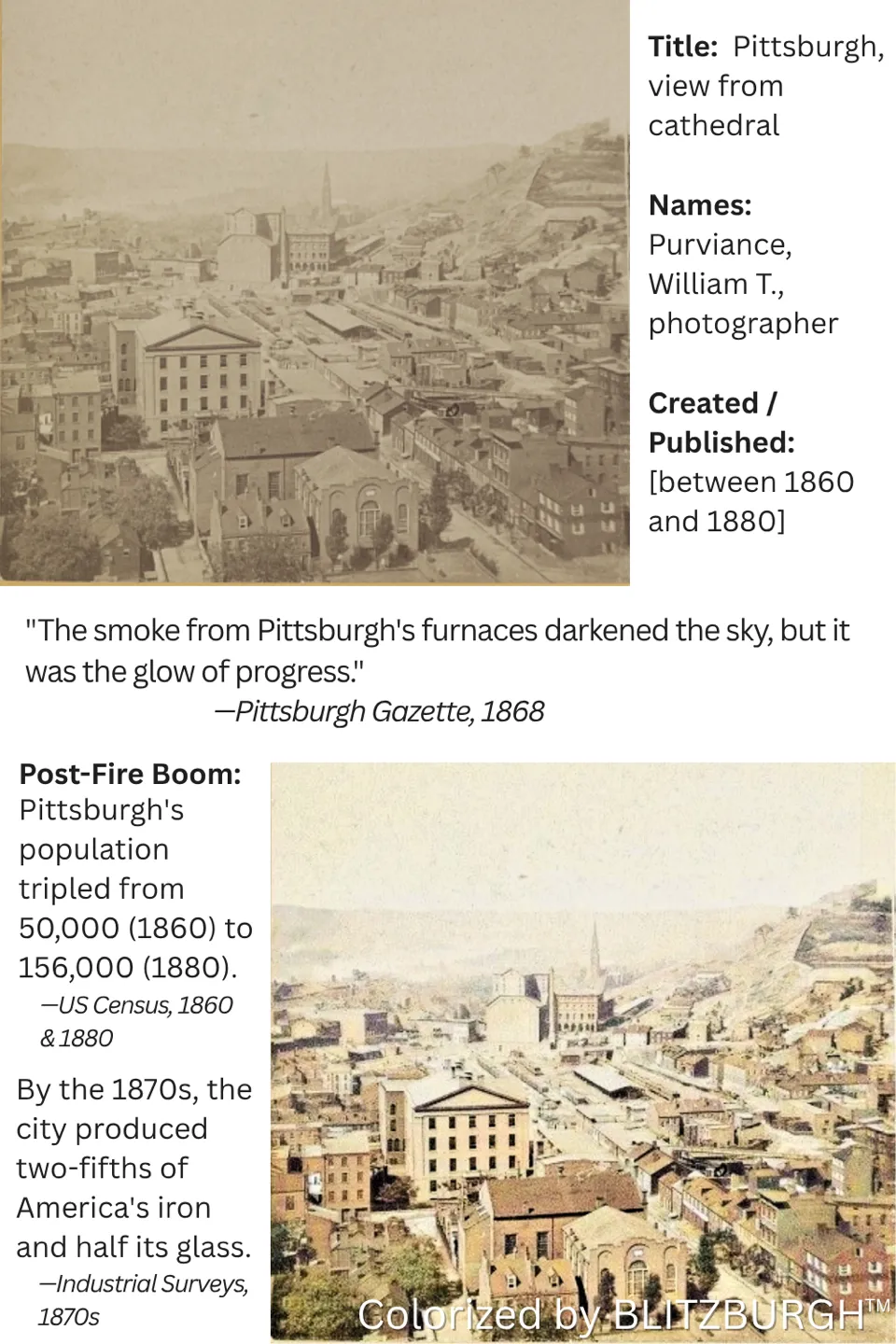
By the 1870s, Pittsburgh had transformed into an industrial powerhouse. Population tripled from 50,000 to 156,000. The city that refused to die became the city that built America.
"In two months from the time of the terrible destruction of property, enough to dishearten almost any other people...a new city, with elegant public and private edifices, has arisen from the ashes of the old. Such a people will not continue depressed; if struck down by sudden calamity, they will rise again and move onward, overcoming all obstacles."
—H.M. Brackenridge, letter, June 1845
GALLERY II
Pittsburgh's Industrial Dominance | 1870s-1920s
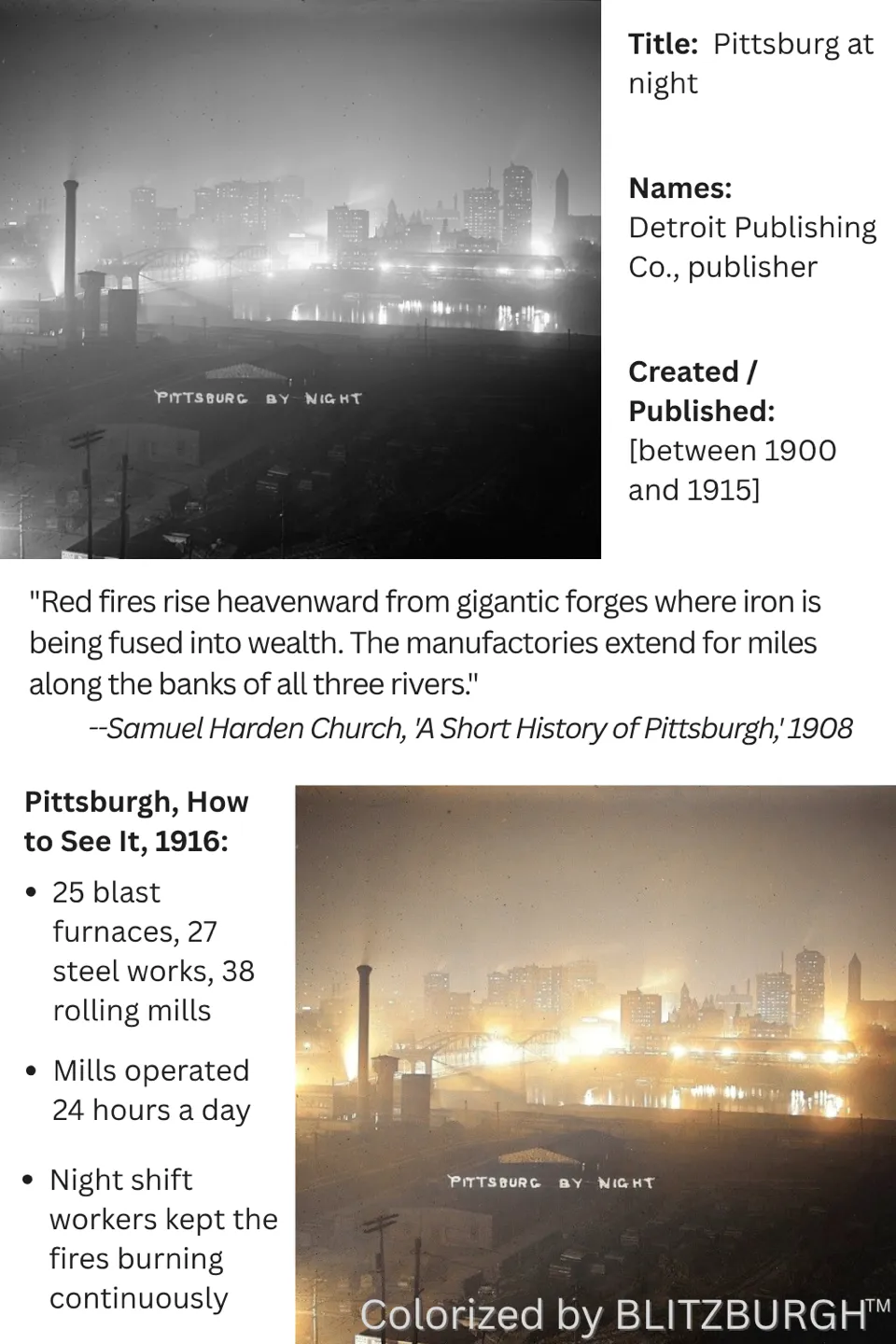
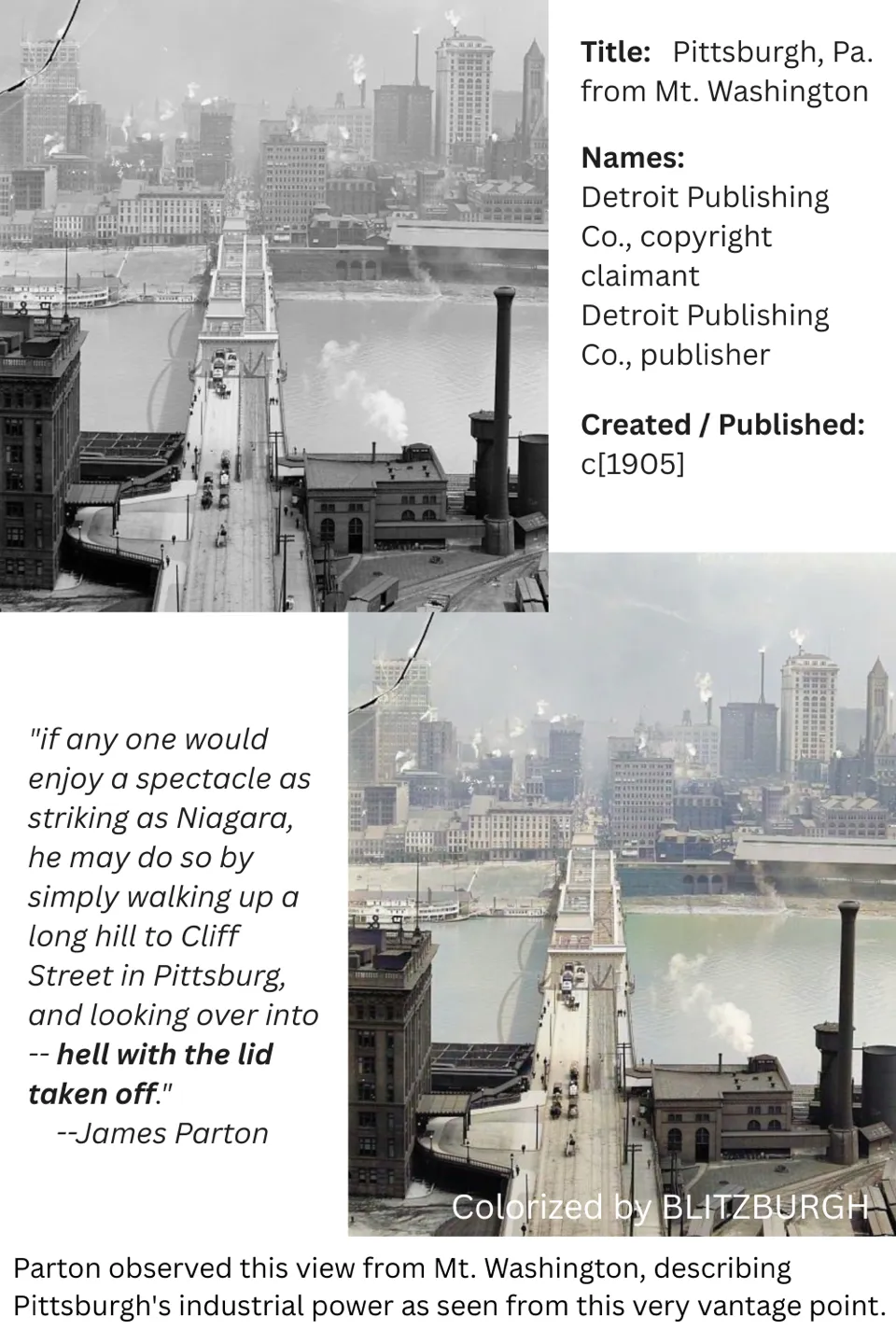
By 1916, Pittsburgh operated 25 blast furnaces, 27 steel works, and 38 rolling mills—running 24 hours a day. The night shift kept the fires burning continuously. From Mount Washington, observers looked down upon an inferno of industry: "hell with the lid taken off." This wasn't an insult. It was a declaration of power.
James Parton stood on Mount Washington and witnessed Pittsburgh's industrial fury. His description—"hell with the lid taken off"—became the city's badge of honor. This was the view that told the world: Pittsburgh means business.
Red fires rose heavenward from gigantic forges where iron was being fused into wealth. The manufactories extended for miles along all three rivers. Pittsburgh at night was a spectacle of American industrial power.
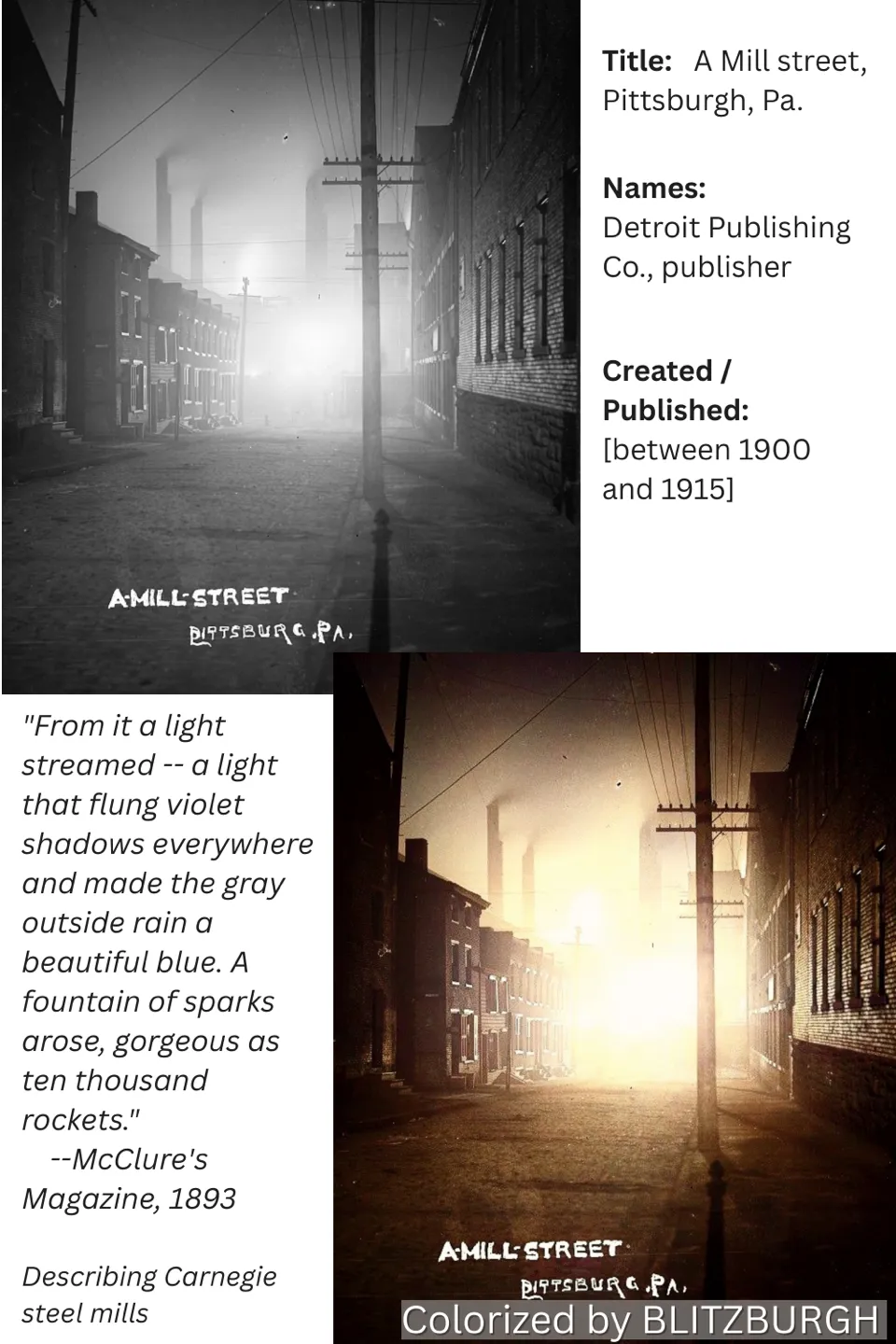
On Mill Street, violet shadows danced between brick walls as furnace light transformed the gray Pittsburgh sky into something beautiful. From darkness came illumination—not just of steel, but of possibility. This was the daily reality for workers: walking through fire to build America's future.
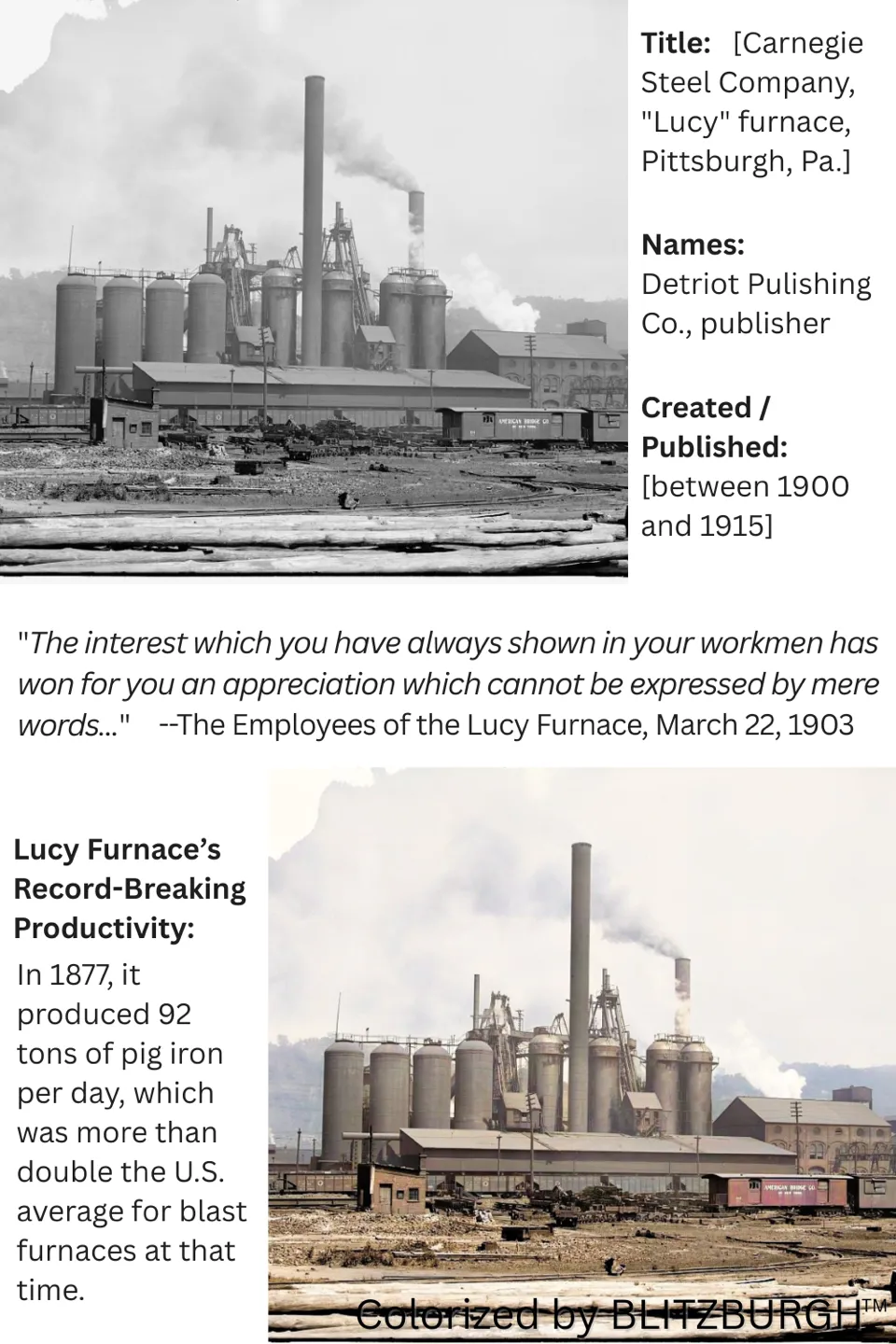
In 1877, the Lucy Furnace produced 92 tons of pig iron per day—more than double the U.S. average. The employees knew what they had achieved: "The interest which you have always shown in your workmen has won for you an appreciation which cannot be expressed by mere words."
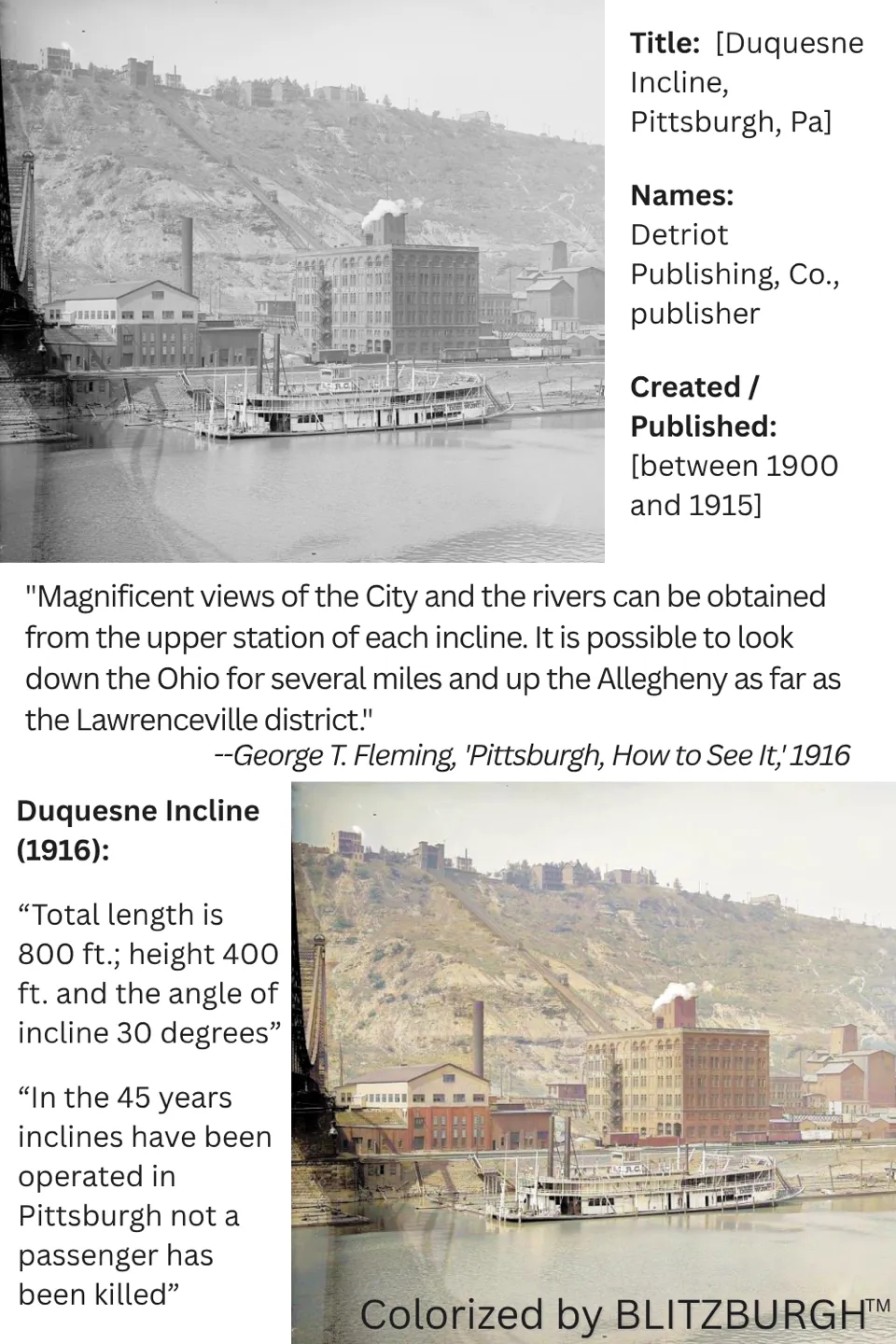
The Duquesne Incline climbed 800 feet at a 30-degree angle. In 45 years of operation, not a single passenger was killed. From the top: magnificent views of the city and rivers, extending miles in every direction. This was Pittsburgh's safe spectacle.
"If any one would enjoy a spectacle as striking as Niagara, he may do so by simply walking up a long hill to Cliff Street in Pittsburg, and looking over into—hell with the lid taken off."
—James Parton, 1866
GALLERY III
Workers, Furnaces, and Human Endurance | 1890s-1940s
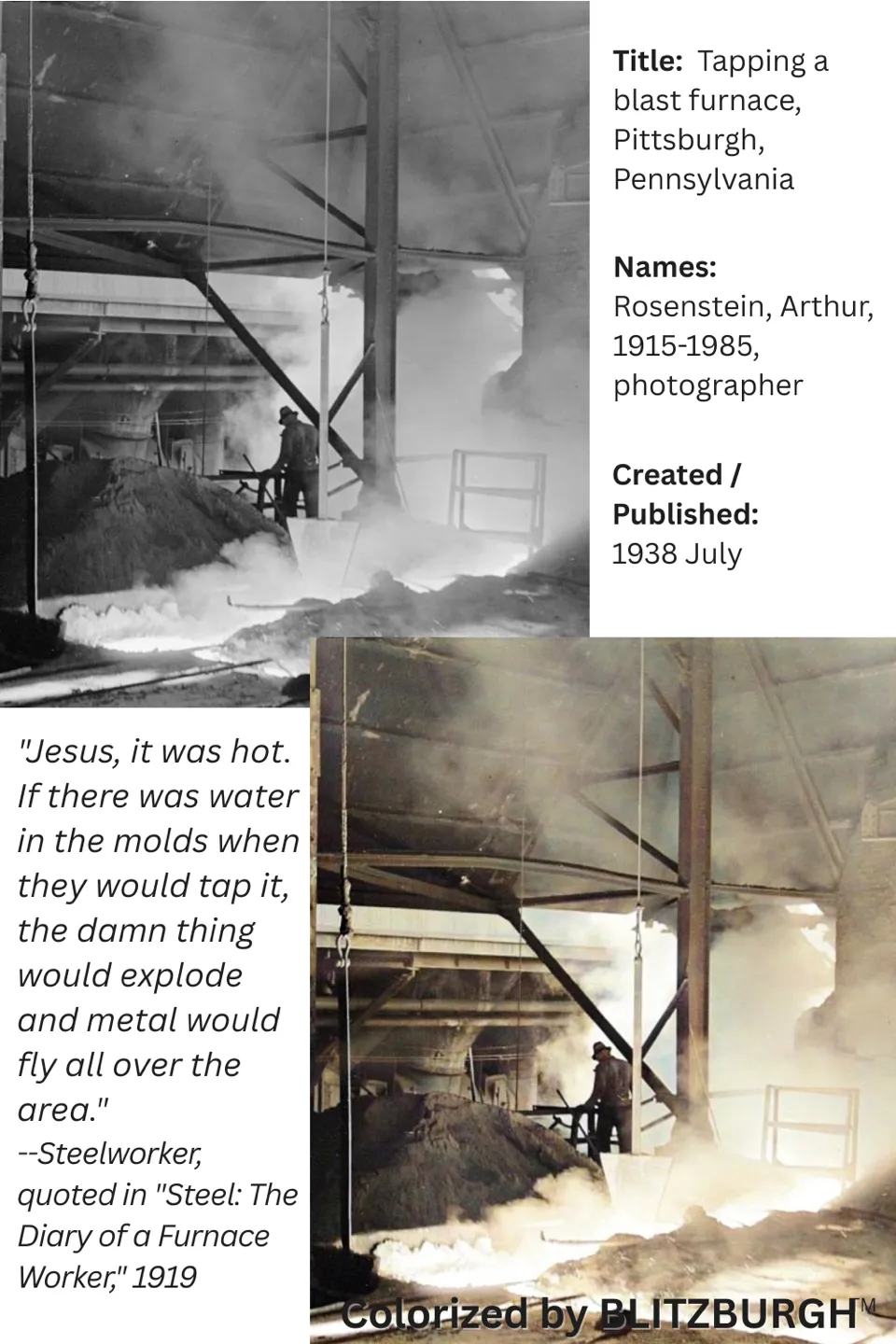
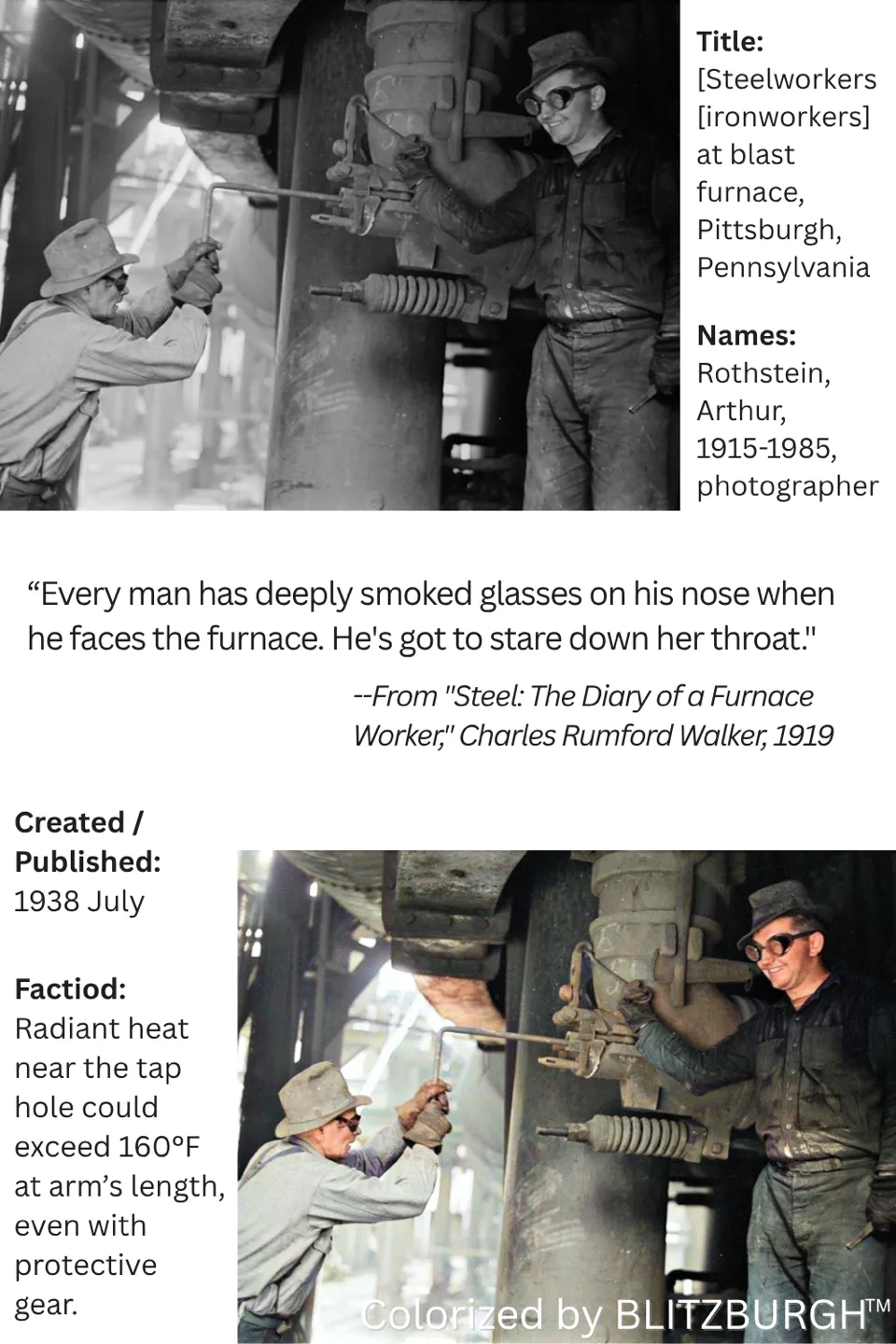
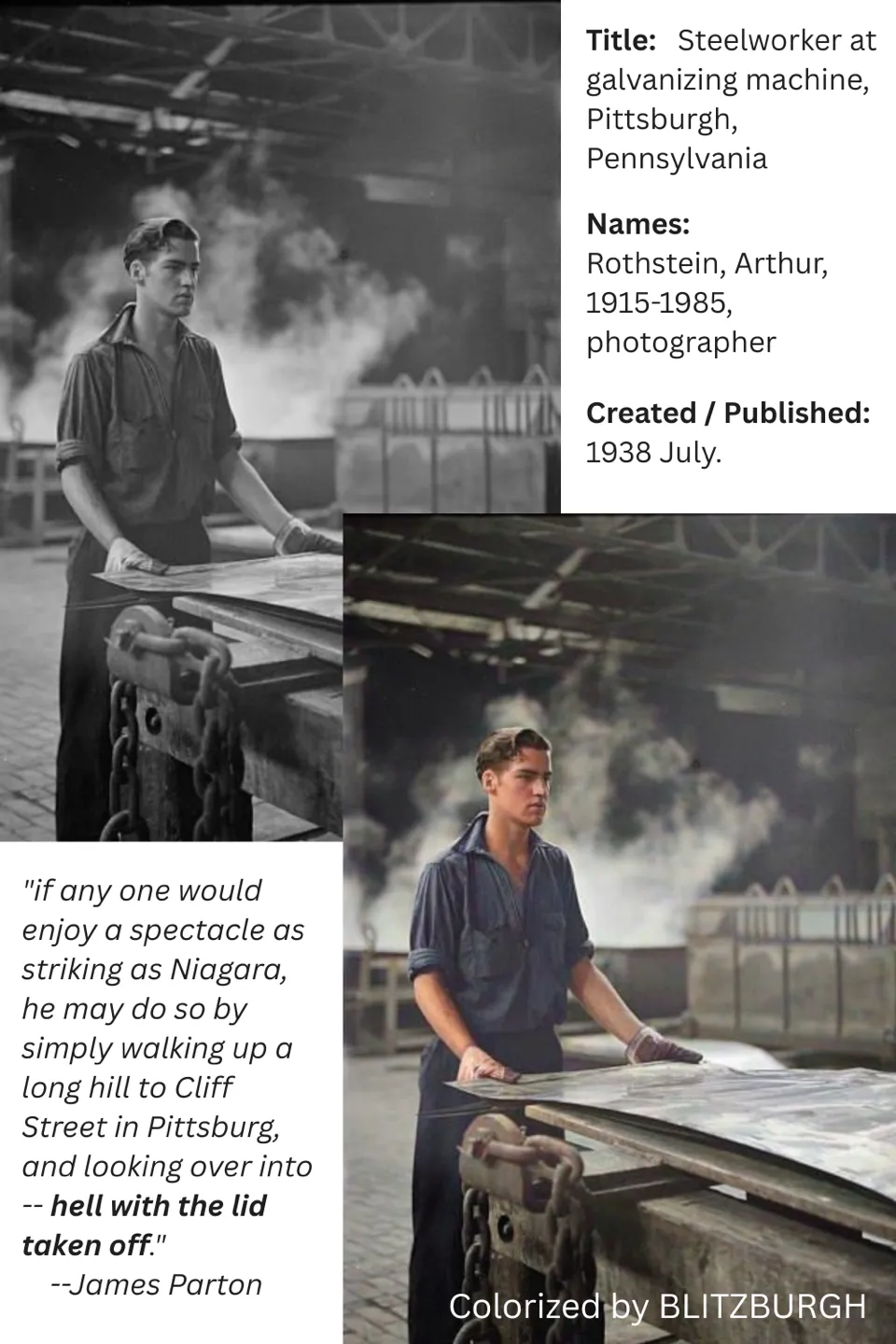
Behind every ton of Pittsburgh steel stood a man who faced the furnace. Radiant heat at 160°F at arm's length. Molten metal that could explode without warning. Twelve-hour shifts in conditions that would break most. These workers didn't just make steel—they embodied it. Tough. Resilient. Unyielding.
"Jesus, it was hot. If there was water in the molds when they would tap it, the damn thing would explode and metal would fly all over the area." The danger was constant. The courage was daily.
"Every man has deeply smoked glasses on his nose when he faces the furnace. He's got to stare down her throat." This was the job: staring into hell, day after day, to forge America's future.
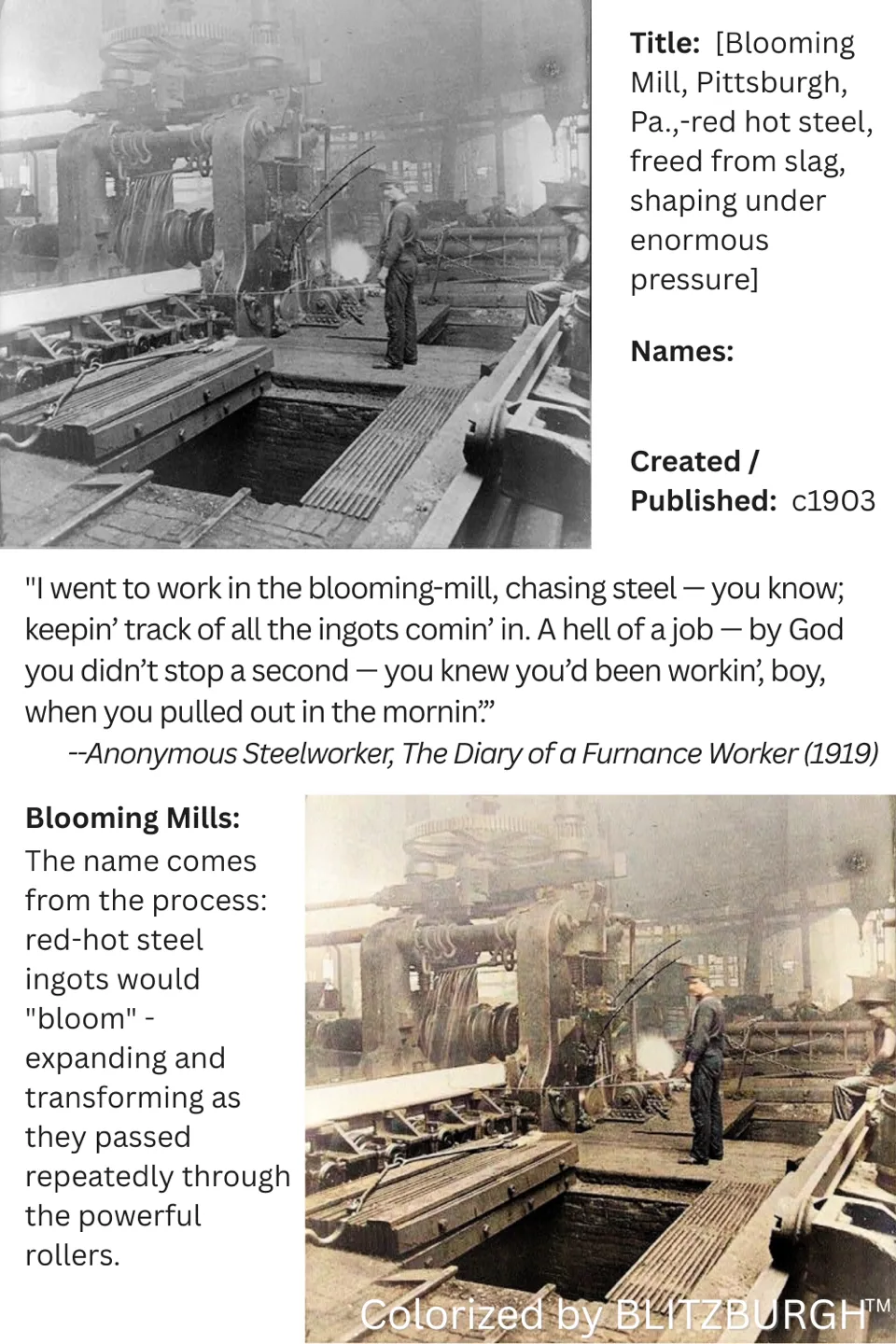
"I went to work in the blooming-mill, chasing steel—you know; keepin' track of all the ingots comin' in. A hell of a job—by God you didn't stop a second—you knew you'd been workin', boy, when you pulled out in the mornin'."
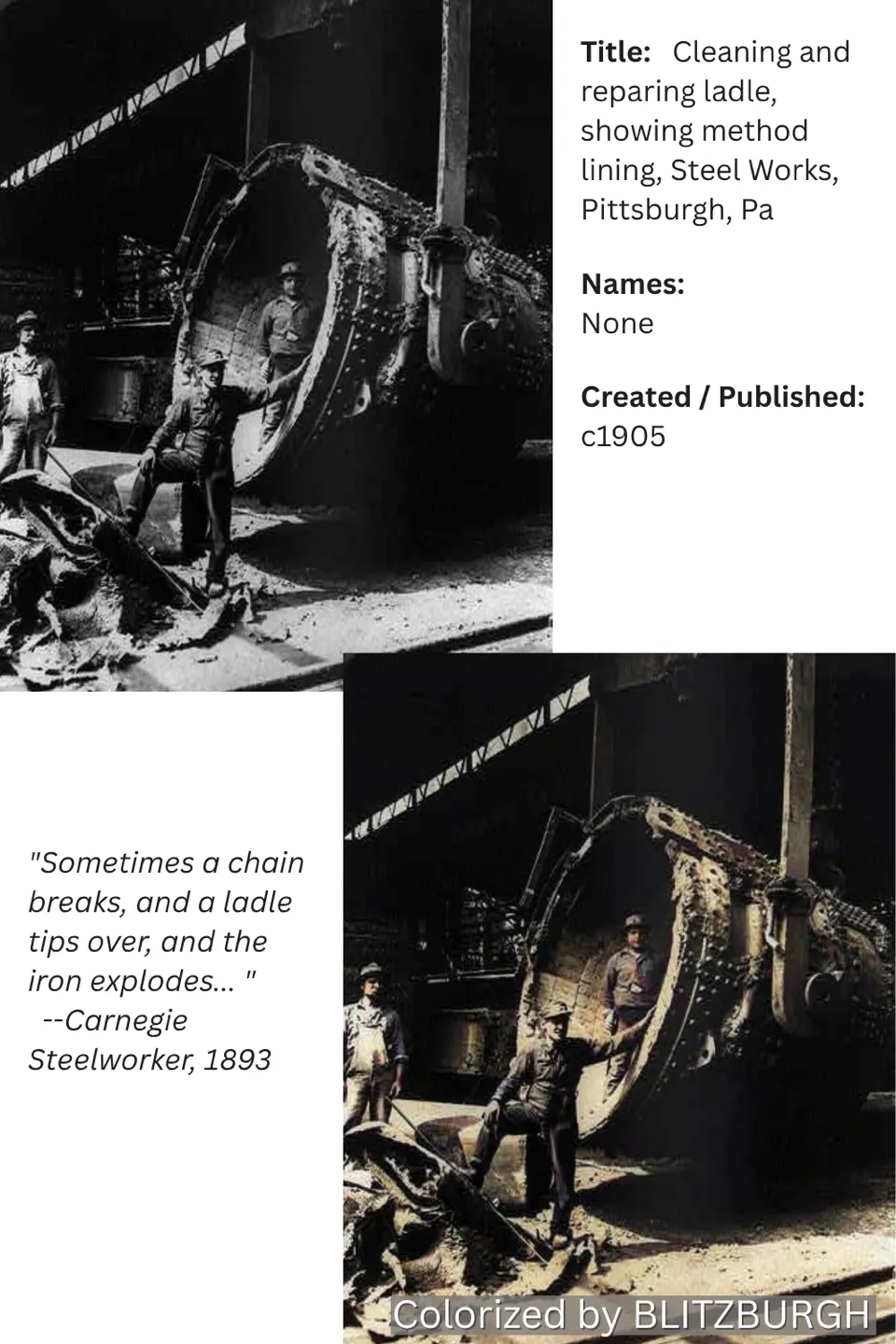
"Sometimes a chain breaks, and a ladle tips over, and the iron explodes..." Carnegie steelworker, 1893. These weren't hypotheticals. This was Tuesday.
Arthur Rothstein captured this steelworker's intensity in 1938. Young but hardened. Focused but weary. This was the face that built America—one that demanded respect, not pity.
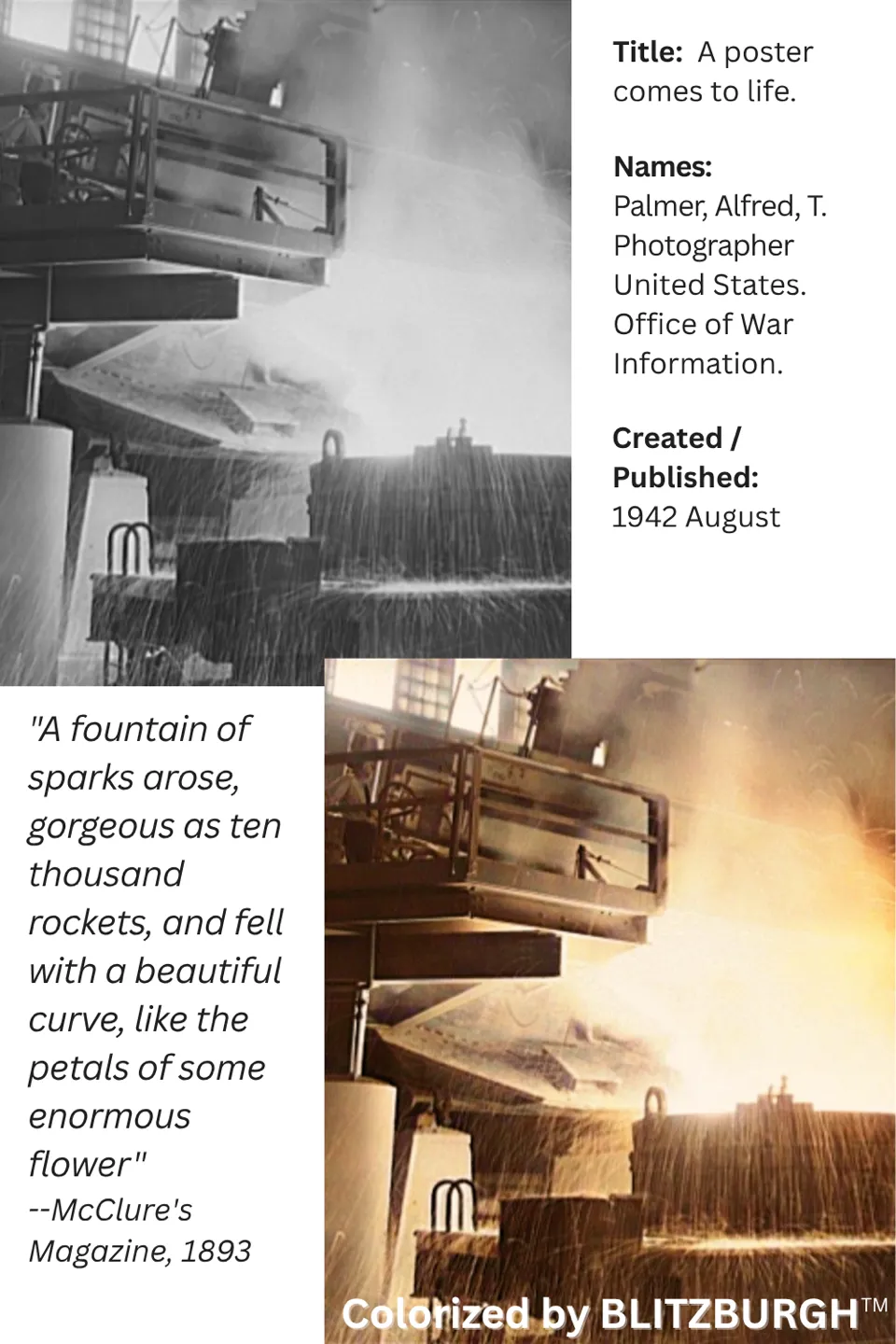
"A fountain of sparks arose, gorgeous as ten thousand rockets, and fell with a beautiful curve, like the petals of some enormous flower." Even McClure's Magazine, 1893, recognized the terrible beauty of steel production.
GALLERY IV
Families, Communities, and Daily Life | 1890s-1940s
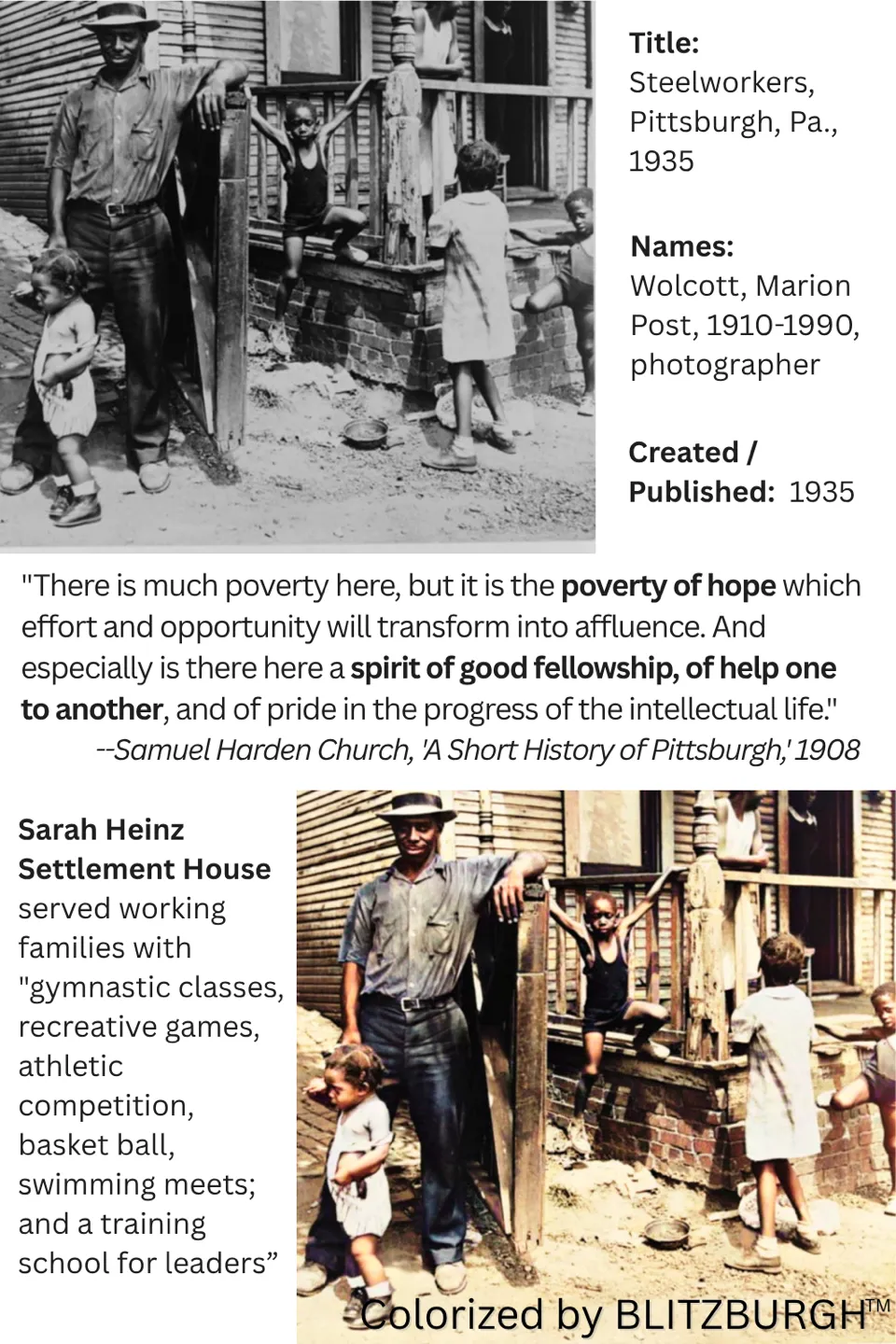
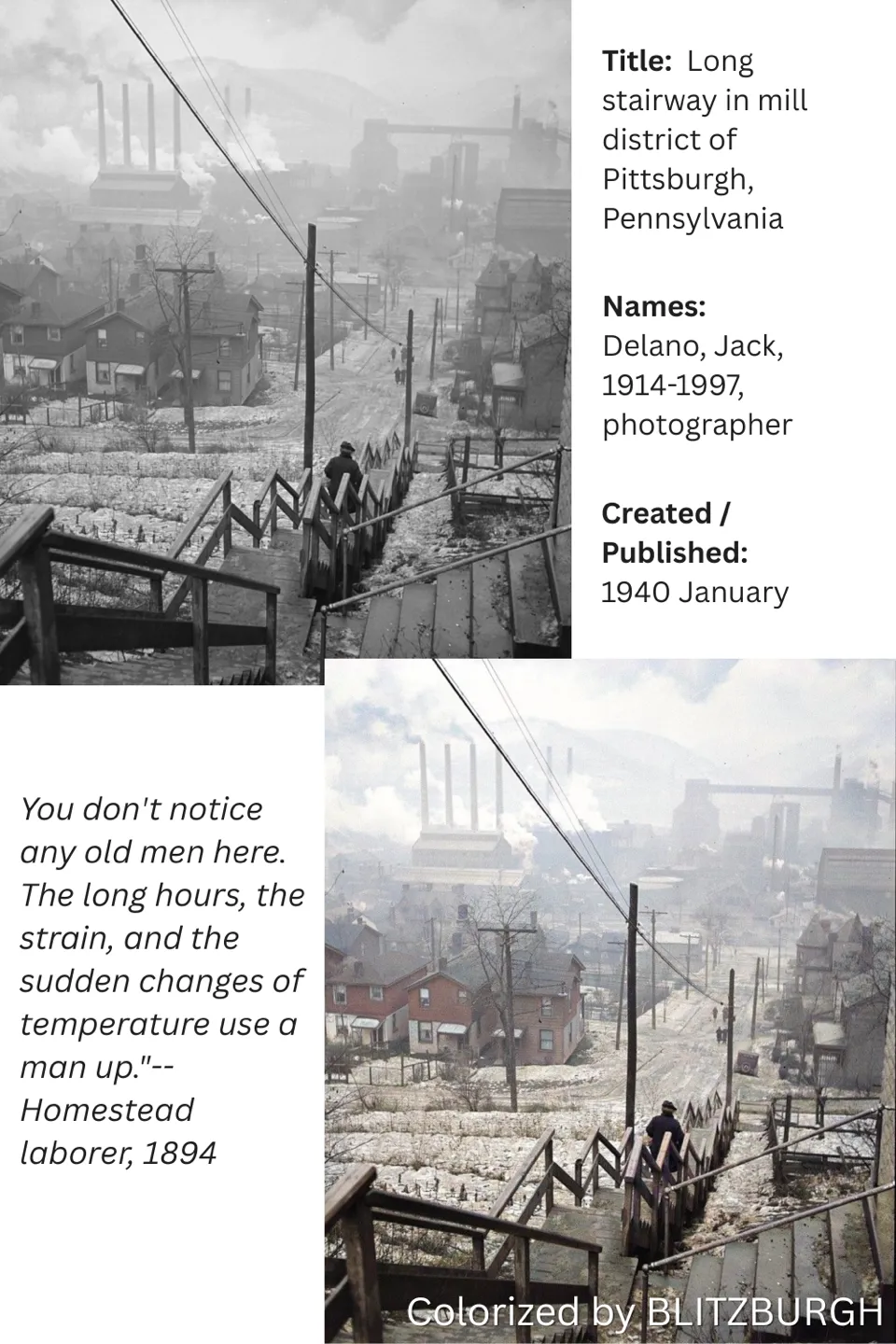
They lived in mill towns and climbed long stairways to hillside homes. They raised families in conditions we'd call slums, but they called home. There was poverty, yes—but Samuel Harden Church recognized it as "the poverty of hope which effort and opportunity will transform into affluence." This was Pittsburgh's human face: resilient, communal, and proud.
Marion Post Wolcott photographed this steelworker and his children in 1935. Note the father's posture—strong, protective, dignified. These families had little, but they had each other and a fierce pride in their work.
"You don't notice any old men here. The long hours, the strain, and the sudden changes of temperature use a man up." A Homestead laborer, 1894. Even the walk home was a testament to endurance.
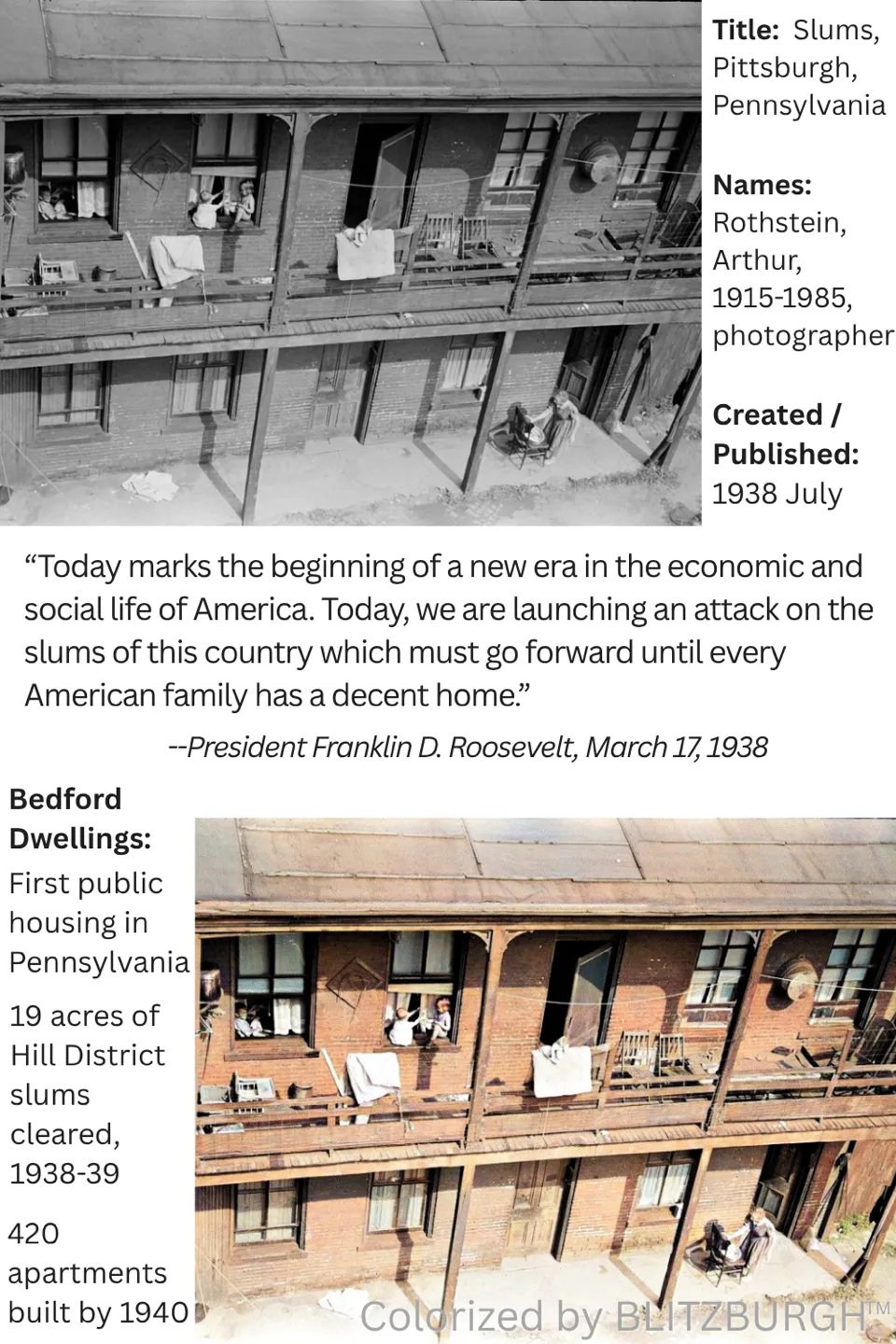
By 1940, Pittsburgh cleared 19 acres of Hill District slums and built 420 apartments—Pennsylvania's first public housing. FDR declared it "the beginning of a new era" in America's fight for decent homes.
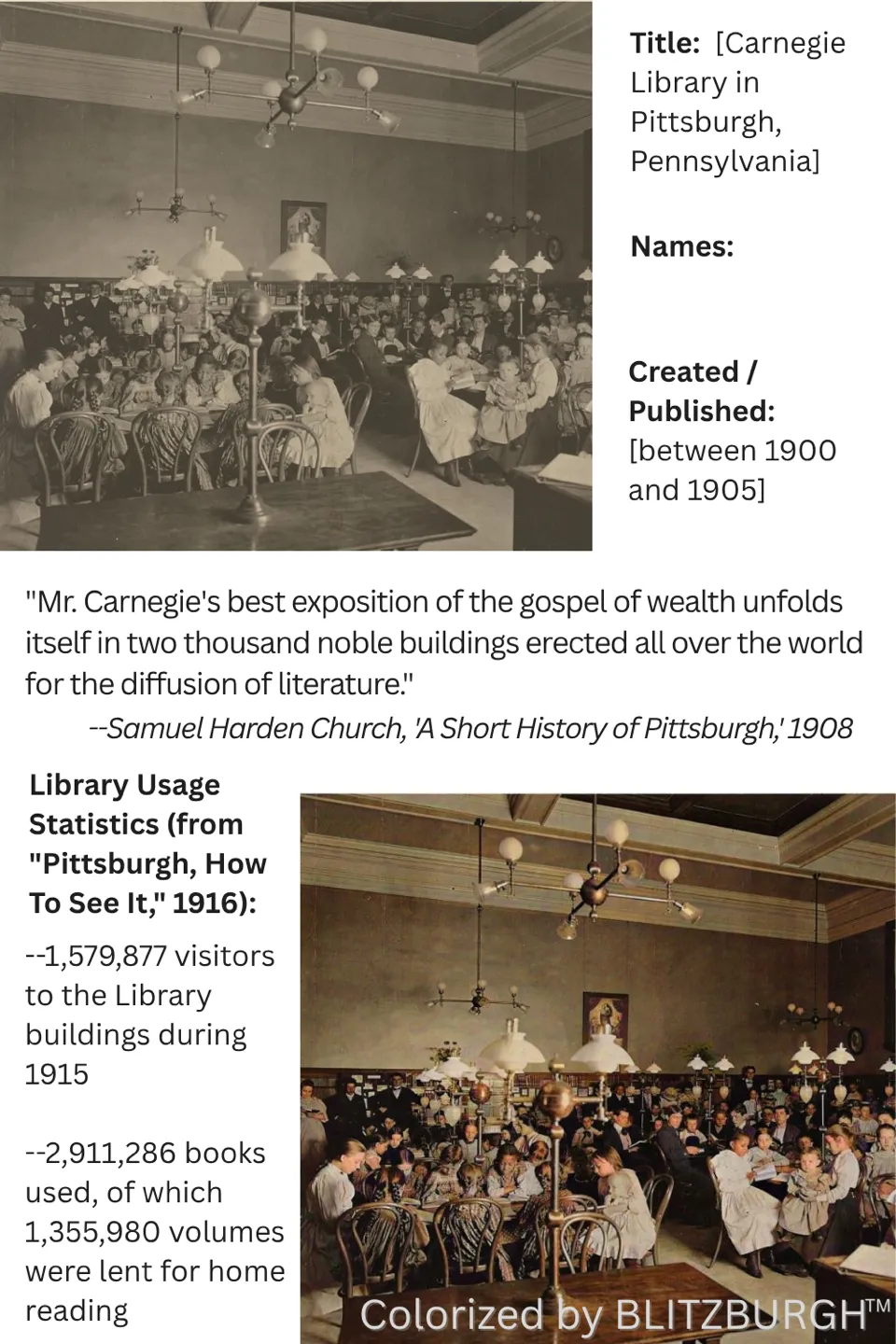
In 1915, Carnegie Library welcomed 1,579,877 visitors who used 2,911,286 books. Steel built wealth, but libraries built opportunity. This was Carnegie's vision: from steel baron to America's greatest philanthropist.
"There is much poverty here, but it is the poverty of hope which effort and opportunity will transform into affluence. And especially is there here a spirit of good fellowship, of help one to another, and of pride in the progress of the intellectual life."
—Samuel Harden Church, 'A Short History of Pittsburgh,' 1908
GALLERY V
Strategic Location & Geographic Destiny | 1753-Present
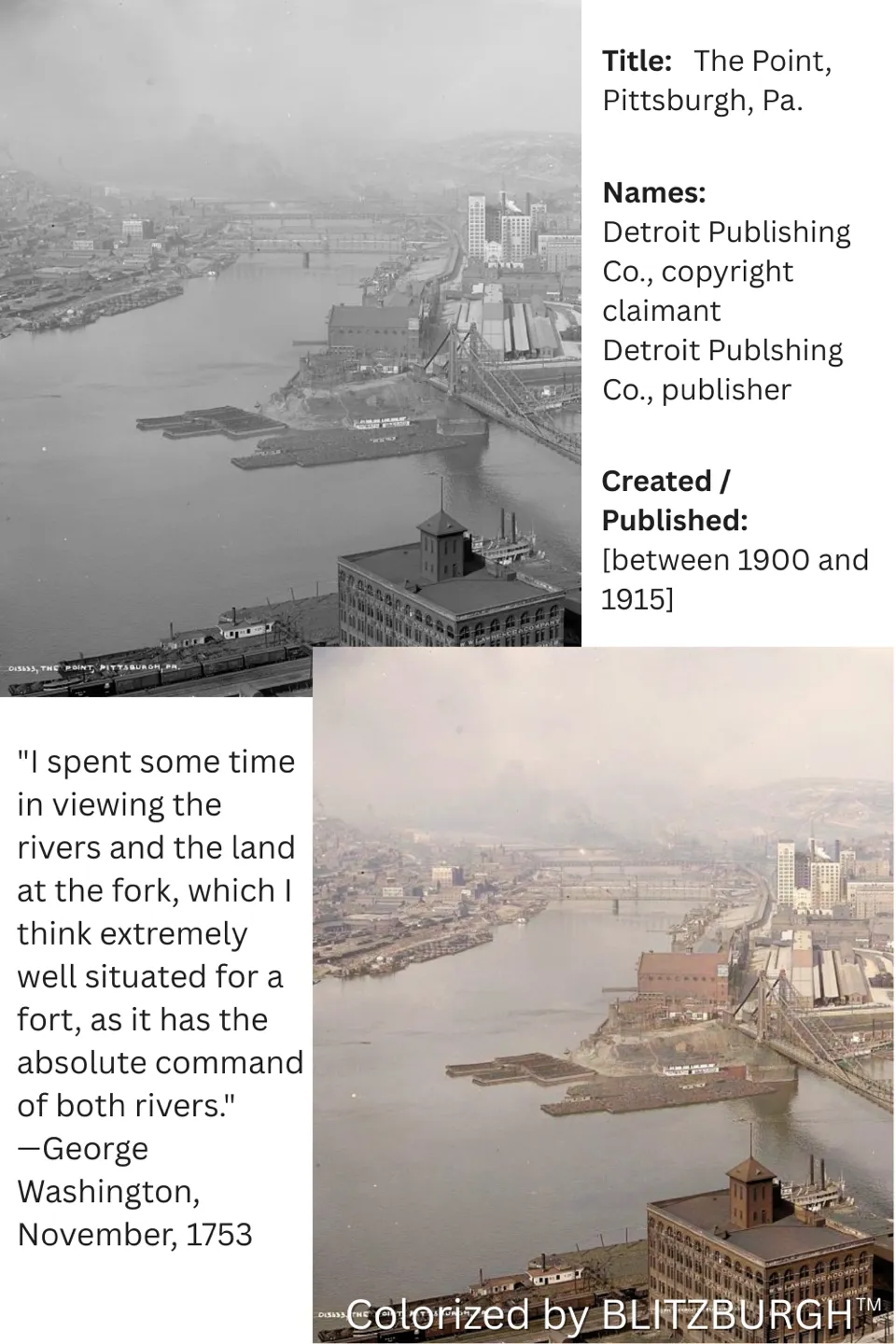
In November 1753, a 21-year-old George Washington stood at the fork of three rivers and recognized its strategic value: "I spent some time in viewing the rivers and the land at the fork, which I think extremely well situated for a fort, as it has the absolute command of both rivers." From military outpost to industrial powerhouse, the Point has always been Pittsburgh's foundation.
Where the Allegheny and Monongahela meet to form the Ohio. The Golden Triangle. The strategic location that George Washington identified in 1753 became the foundation for Fort Pitt in 1758, and ultimately the city of Pittsburgh. Geography is destiny.
Additional galleries exploring Pittsburgh's renaissance, sports heritage, and modern transformation
Not perfect. Not easy. But earned through fire, forged in steel, and built on the backs of those who refused to quit. From the Great Fire's ashes to the furnace's inferno, from mill town poverty to Carnegie's libraries—this is the real Pittsburgh. This is what we celebrate. This is what we wear with pride.
Every M TRIBUS design honors this authentic heritage. From the Great Fire's resilience to the Steel City's dominance.
Explore the Collection